


Description
What is foil insulation?
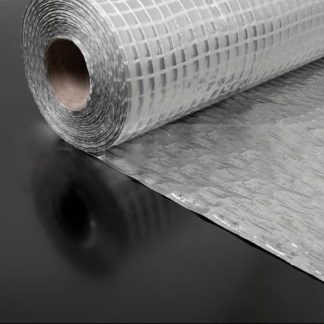
Foil insulation is a thin, reflective membrane – typically aluminium foil bonded to a polyethylene or foam core – installed in walls, lofts, pitched roofs and under floors to reduce radiant heat transfer and control moisture. It works by reflecting radiant heat back towards its source and requires a 20 – 25 mm air gap on at least one face to perform correctly.
How foil insulation works
Heat moves through a building envelope in three ways: radiation, conduction and convection. Foil insulation, sometimes called reflective foil insulation, targets radiant heat – the main way heat moves in loft and roof spaces – by reflecting ≥ 94% of it back towards its source rather than absorbing it.
The reflective surface has no effect on conduction or convection, which is why foil insulation is typically installed alongside mineral wool or rigid PIR board to address all three modes.
The air gap is not optional. Without a clear 25 mm air gap on the warm side, the foil cannot reflect – it conducts instead, and the insulation will not perform as rated.
What is the difference between foil insulation, radiant barrier and reflective insulation?
These three terms describe related but distinct products:
Radiant barrier is a single-layer foil sheet with no insulating core and no standalone thermal resistance. It must face a clear 25 mm air gap on the warm side to reflect rather than conduct, and must be installed alongside mineral wool or PIR board – it will not achieve the U-values required under Approved Document L on its own.
Reflective insulation is a multi-layer product – aluminium foil outer layers bonded to a bubble, foam or fleece core. The core gives it a measurable thermal resistance, contributing directly to the U-value of the build-up, not just the reflective surface performance.
Foil insulation is the umbrella term for both – in practice most commonly a multi-layer reflective membrane acting as both a radiant barrier and a vapour control layer in a single sheet. It is also sold as thermal wrap insulation.
Key Features
- UPGRADE FROM STANDARD VCL – Combines vapour control with a reflective surface for enhanced performance compared to standard polyethylene membranes
- THERMAL EFFICIENCY – Supports improved thermal efficiency and helps reduce heat loss when used within insulated wall, roof and floor systems
- SUPPORTS THERMAL EFFICIENCY – Can contribute to reducing heat loss and improving thermal efficiency when used within insulated wall, roof and floor systems
- HELPS IMPROVE AIRTIGHTNESS – Can be taped and sealed to form a continuous airtight layer, helping improve overall building envelope performance
- HELPS RETAIN WARM AIR – Supports improved internal comfort by reducing unwanted air movement within wall, roof and floor constructions
- PROTECTS BUILDING STRUCTURE – Helps protect the building fabric from moisture damage and long-term degradation
- MAINTAINS INSULATION PERFORMANCE – Helps prevent moisture ingress into insulation, preserving long-term thermal performance
- SUITABLE FOR NEW BUILD & REFURBISHMENT – Ideal for both new construction and renovation projects across residential and commercial applications
- FORMS A CONTINUOUS SEALED LAYER – Designed to be used with appropriate tapes to create a continuous vapour control and airtightness layer
- DESIGNED FOR CORRECT INSTALLATION – Installed on the warm side of insulation in accordance with standard construction practice
- IMPROVES INTERNAL COMFORT – Helps regulate air and moisture movement within the building, supporting a more stable internal environment
Technical Highlights
- EN 13984 compliant vapour control layer
- Water vapour resistance: 2.5 × 10¹¹ m²·s·Pa/kg
- Equivalent air layer thickness (Sd): approx. 50m
- Reflective aluminium surface provides radiant heat reflection
- Independently tested reflective performance by the British Board of Agrément (BBA)
Applications
Suitable for use in a wide range of construction applications including:
- Timber frame wall systems
- Masonry cavity walls
- Insulated pitched roofs
- Loft conversions
- Internal insulation systems
- Floors and ceilings requiring vapour control
- Underfloor heating floor constructions; installed on the warm side of the insulation.
Technical Specification
| Property | Performance | Standard |
| Product Type | Reflective Vapour Control Layer | EN 13984 |
| Water Vapour Resistance | 2.5 × 10¹¹ m²·s·Pa/kg | EN 1931 |
| Equivalent Air Layer Thickness (Sd | ) 50m | EN 1931 |
| Surface Finish | Metallised Aluminium Reflective Layer | |
| Emissivity | 0.47 | BBA Tested |
| Tensile Strength MD | 220 N | EN 12311 |
| Tensile Strength TD | 150 N | EN 12311 |
| Tear Resistance | 100 N | EN 12310 |
| Reaction to Fire | Class E | EN 13501 |
How to install foil insulation
- Check orientation before fixing – reflective face towards the air gap on the warm side of the build-up. In a loft or pitched roof that means shiny side facing down towards the room; in walls and floors the reflective face always points towards the nearest air gap.
- Fix to the structure using staples, clout nails, insulation fixings or contact adhesive at 150–300 mm centres – pull the membrane taut but not overstretched across the framing.
- Create the air gap using battens where the structure does not already provide one. Minimum 25 mm clear air gap on the warm side – without it the foil conducts rather than reflects.
- Lap all joints by a minimum 100 mm on both edges. Butt joints are not acceptable – any gap in the membrane breaks the vapour control layer.
- Seal every lap, edge and overlap with foil tape – press firmly along the full length and run a roller or squeegee over the tape to ensure full contact.
Seal all service penetrations – pipes, cables and fixings that pass through the membrane must be sealed with foil tape or sealant before boarding. Any unsealed penetration will reduce airtightness and allow moisture into the build-up.
Certifications and Testing
- EN 13984 compliant vapour control membrane
- Declaration of Performance available
- Reflective surface independently tested by the British Board of Agrément (BBA)
- Manufactured in accordance with Construction Products Regulation (CPR)
Downloads
- Product Technical Datasheet
- Declaration of Performance (DoP)
- BBA Emissivity Test Report
- Installation Guidance Document
Frequently Asked Questions
What is foil insulation? Foil insulation is a reflective membrane – aluminium foil bonded to a polyethylene or foam core – installed in walls, lofts, roofs and floors to reduce radiant heat loss and act as a vapour control layer.
Which way should foil insulation face? The reflective face should point inward towards the heated space. A clear, unventilated air gap of 25 mm must be maintained between the foil and the nearest surface for it to reflect rather than conduct.
Does foil insulation work without an air gap? No. The reflective performance depends on an adjacent air gap of at least 25 mm. Without it the foil conducts heat rather than reflects it and thermal performance drops significantly.
Can foil insulation be used in a loft? Yes – fix to the underside of rafters or between joists with the reflective face towards the room. It is typically used alongside mineral wool or PIR board as the primary thermal layer, with the foil membrane adding radiant heat reflection and acting as the vapour control layer.
Is foil insulation a vapour barrier? Most aluminium foil membranes act as a vapour control layer, provided all seams are overlapped by a minimum 100 mm, sealed with aluminium foil tape, and all service penetrations are taped before boarding.
Is foil insulation the same as bubble foil insulation? Bubble foil is one type of foil insulation – aluminium facings bonded to a bubble-wrap core. Other types use closed-cell foam or multi-layer woven fleece cores. All work on the same reflective principle but differ in thickness, thermal resistance and suitability for different applications.
How thick is foil insulation? Typical multi-layer foil membranes are 0.5–4 mm thick depending on the core. Thermal performance comes from the reflective surface and air gap, not material thickness – a thicker product does not automatically mean better performance.
What U-value does foil insulation achieve? Achievable U-values depend on the complete wall or roof build-up. A 90 g/m² aluminium foil membrane in an 89 mm stud wall can achieve around 0.35 W/m²K. Always check the manufacturer datasheet for your specific build-up and application.
Does foil insulation replace fibreglass or mineral wool? No – it complements them. Most build-ups use a bulk insulant such as PIR board or mineral wool as the primary thermal layer, with the foil membrane added on the warm side to control radiant heat and provide vapour resistance. Foil insulation alone will not meet the U-values required under Approved Document L.

Reviews
There are no reviews yet.