


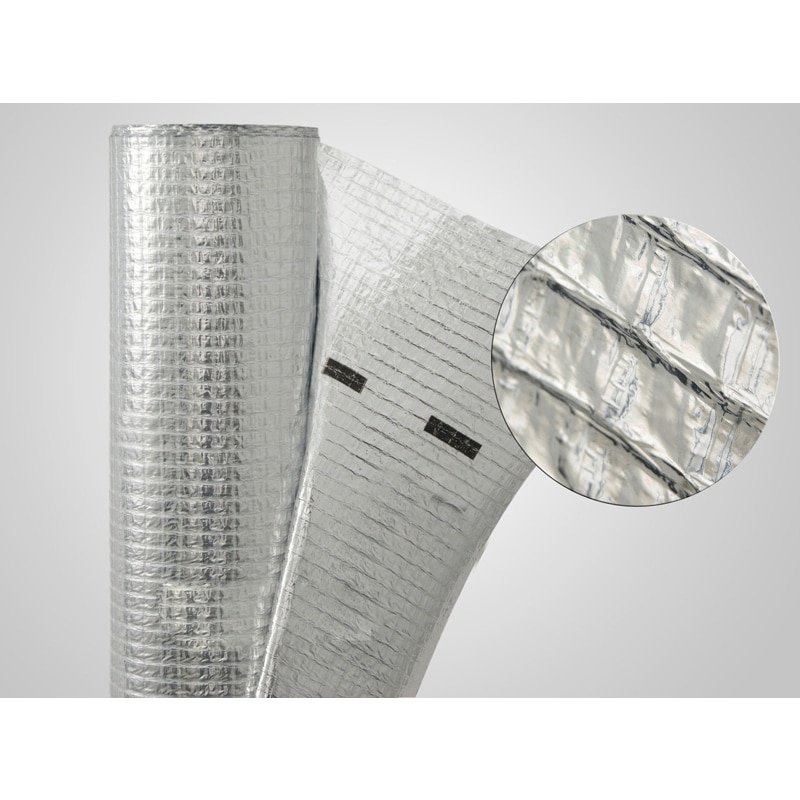


Description
UPGRADE FROM STANDARD VCL – Combines vapour control with a reflective surface for enhanced performance compared to standard polyethylene membranes
THERMAL EFFICIENCY – Supports improved thermal efficiency and helps reduce heat loss when used within insulated wall, roof and floor systems
SUPPORTS THERMAL EFFICIENCY – Can contribute to reducing heat loss and improving thermal efficiency when used within insulated wall, roof and floor systems
HELPS IMPROVE AIRTIGHTNESS – Can be taped and sealed to form a continuous airtight layer, helping improve overall building envelope performance
HELPS RETAIN WARM AIR – Supports improved internal comfort by reducing unwanted air movement within wall, roof and floor constructions
PROTECTS BUILDING STRUCTURE – Helps protect the building fabric from moisture damage and long-term degradation
MAINTAINS INSULATION PERFORMANCE – Helps prevent moisture ingress into insulation, preserving long-term thermal performance
SUITABLE FOR NEW BUILD & REFURBISHMENT – Ideal for both new construction and renovation projects across residential and commercial applications
FORMS A CONTINUOUS SEALED LAYER – Designed to be used with appropriate tapes to create a continuous vapour control and airtightness layer
DESIGNED FOR CORRECT INSTALLATION – Installed on the warm side of insulation in accordance with standard construction practice
IMPROVES INTERNAL COMFORT – Helps regulate air and moisture movement within the building, supporting a more stable internal environment
Technical Highlights
- EN 13984 compliant vapour control layer
- Water vapour resistance: 2.5 × 10¹¹ m²·s·Pa/kg
- Equivalent air layer thickness (Sd): approx. 50m
- Reflective aluminium surface provides radiant heat reflection
- Independently tested reflective performance by the British Board of Agrément (BBA)
Applications
Suitable for use in a wide range of construction applications including:
- Timber frame wall systems
- Masonry cavity walls
- Insulated pitched roofs
- Loft conversions
- Internal insulation systems
- Floors and ceilings requiring vapour control
- Underfloor heating floor constructions; installed on the warm side of the insulation.
Technical Specification
| Property | Performance | Standard |
| Product Type | Reflective Vapour Control Layer | EN 13984 |
| Water Vapour Resistance | 2.5 × 10¹¹ m²·s·Pa/kg | EN 1931 |
| Equivalent Air Layer Thickness (Sd | ) 50m | EN 1931 |
| Surface Finish | Metallised Aluminium Reflective Layer | |
| Emissivity | 0.47 | BBA Tested |
| Tensile Strength MD | 220 N | EN 12311 |
| Tensile Strength TD | 150 N | EN 12311 |
| Tear Resistance | 100 N | EN 12310 |
| Reaction to Fire | Class E | EN 13501 |
Installation Guidance
The membrane should be installed on the warm side of the insulation layer. The reflective aluminium surface should face an internal air cavity where possible to maximise radiant heat reflection.
All joints should be overlapped and sealed using appropriate vapour control tapes to maintain airtightness. Service penetrations should also be sealed.
Note – this VCL is not self adhesive and requires mechanically fixing.
Certifications and Testing
- EN 13984 compliant vapour control membrane
- Declaration of Performance available
- Reflective surface independently tested by the British Board of Agrément (BBA)
- Manufactured in accordance with Construction Products Regulation (CPR)
Downloads
- Product Technical Datasheet
- Declaration of Performance (DoP)
- BBA Emissivity Test Report
- Installation Guidance Document
Frequently Asked Questions
What is a vapour control layer?
A vapour control layer helps prevent moisture vapour passing into insulation and structural elements, reducing the risk of condensation.
Which side should face the room?
The reflective foil side should face the internal air cavity where possible.
Can this membrane be used in roofs and walls?
Yes, it is suitable for walls, roofs, floors and ceilings where vapour control is required.
How do you fix a vapour control layer (VCL) to rafters?
Fix the VCL to the underside of rafters on the warm side of the insulation using staples or clout nails at 150–300 mm centres. Install the membrane taut but not overstretched.
- Overlap joints by min. 100 mm and seal with suitable VCL or foil tape
- Seal all edges and penetrations to maintain airtightness
- A service void (e.g. 25 mm battens) is recommended to prevent damage
- The foil side should face the internal air gap where possible
This ensures effective vapour control, airtightness and long-term performance.
Reviews
There are no reviews yet.