


26 Jul 2026
What Is a Vapour Control Layer (VCL)? The Complete UK Guide
A vapour control layer (VCL) is a membrane fitted on the warm side of insulation to stop moist indoor air passing into the structure, where it would condense and cause damp, mould and rot. In UK homes it's typically an aluminium foil membrane installed behind plasterboard on walls and ceilings.
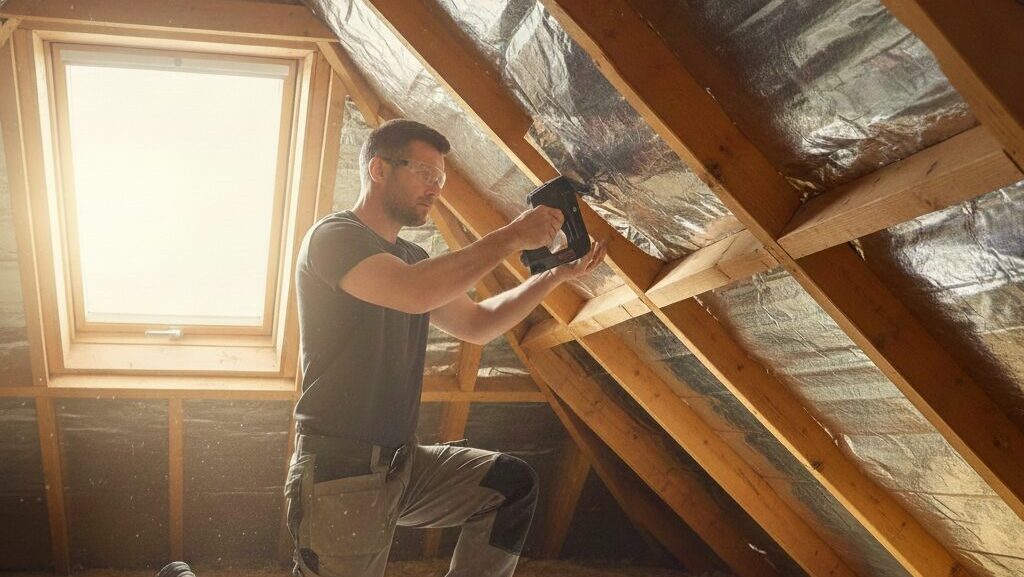
What is a vapour control layer, and what does it do?
Every home generates moisture. Cooking, showering, drying laundry, even breathing puts several litres of water vapour into the air of a typical house every day. Warm air holds far more moisture than cold air, so that vapour sits invisibly in your heated rooms until it meets a cold surface — at which point it condenses back into liquid water.
A vapour control layer is the membrane that stops that warm, moist internal air from drifting into the wall, roof or floor build-up in the first place. It is fitted on the warm side of the insulation, immediately behind the plasterboard on walls and ceilings, so the moisture never reaches the cold outer layers where it could condense.
The failure it prevents is called interstitial condensation — condensation forming inside the construction rather than on the surface of a window. It is far more damaging than surface condensation precisely because you cannot see it. Moisture accumulates within the insulation and against the timber frame, and by the time it shows itself as a damp patch on the ceiling or a musty smell in a loft conversion, rot may already be well established.
A correctly installed VCL does three things at once: it blocks vapour diffusion through the layer, it improves airtightness when the laps and edges are taped, and — if you use an aluminium foil membrane — it reflects radiant heat back into the room, adding a small thermal benefit alongside the moisture control.
VCL vs vapour barrier vs breathable membrane — what’s the difference?
These three terms cause more confusion on site than almost anything else in the membrane world, largely because two of them mean roughly the same thing and the third is the opposite.
| Term | What it does | Where it goes | Vapour resistance |
|---|---|---|---|
| Vapour control layer (VCL) | Restricts moisture passing into the structure | Warm side, behind plasterboard | High |
| Vapour barrier | In UK practice, used interchangeably with VCL | Warm side, behind plasterboard | High |
| Breathable membrane | Blocks liquid water but lets vapour escape outwards | Cold side, over rafters or sheathing | Very low (vapour permeable) |
| Bitumen felt (1F/1B) | Traditional non-breathable underlay | Cold side, over rafters | Moderate to high |
In strict technical language there is a distinction. A true vapour barrier is a layer of very high vapour resistance — effectively impermeable. A vapour control layer is a layer of controlled, defined resistance that limits vapour movement to an acceptable level. In UK residential practice the two words are used interchangeably, and the product you buy as a “vapour barrier” is almost always what a designer would specify as a VCL.
The breathable membrane is the genuine opposite. It is designed to let any vapour that does find its way into the build-up escape outwards to the atmosphere, while stopping wind-driven rain from getting in. The two products are partners, not alternatives — the sealed layer goes inside, the breathable layer goes outside.
Where does a VCL go? (Warm side of insulation — walls, ceilings, floors)
The single rule that governs every VCL installation is this: the vapour control layer always goes on the warm side of the insulation. Warm side means the side facing the heated interior of the building.
In a stud wall, the insulation sits between the studs and the VCL is stapled or taped across the face of the studs, on the room side, before the plasterboard goes on. In a ceiling or a room-in-roof conversion, the VCL runs across the underside of the rafters or joists, again immediately behind the plasterboard. In a floor with underfloor heating, a foil membrane is laid above the floor insulation and below the screed, where it both controls vapour and reflects heat upward into the room.
There is a useful rule of thumb for the rare cases where you are unsure: no more than one third of the total insulation should sit on the warm side of the VCL. In practice, in almost all UK residential work, all of the insulation is on the cold side of the VCL and the membrane sits directly against the plasterboard.
Common positions in practice:
- Stud and timber-frame walls — across the face of the studs, behind plasterboard
- Pitched roofs and loft conversions — under the rafters, behind plasterboard
- Flat and warm roofs — directly below the insulation deck
- Suspended and solid floors — above the insulation, below screed or deck
- Garden rooms, garages and outbuildings — on the internal face of the frame
Do I need a vapour control layer?
For most insulated elements in a UK home, yes. Any construction where you have added insulation and there is now a warm side and a cold side is a candidate for a VCL, and a condensation risk analysis will usually confirm one is needed.
You almost certainly need a VCL when insulating a stud or timber-frame wall, converting a loft into habitable space, building a warm or cold pitched roof over a heated room, constructing a garden room or insulated outbuilding, or fitting insulation to the internal face of a solid wall.
You may not need one — and in some cases should deliberately avoid one — in a cold, well-ventilated loft where the insulation sits at ceiling joist level and the loft space above is fully ventilated to the outside; in a traditional solid-wall building using a breathable lime-based build-up, where trapping moisture would cause more harm than it prevents; and in some panelised systems where a proprietary board or sheathing already provides the vapour control function within the manufacturer’s certified build-up.
If you are working on a historic or solid-walled property, take advice before sealing anything. Older buildings were designed to manage moisture by letting it move through the fabric, and introducing an impermeable layer without understanding the whole build-up can push moisture somewhere worse.
Foil VCL vs polythene VCL — which to choose
Both types will control vapour effectively. The difference is what else they give you and how they behave on site.
| Aluminium foil VCL | Polythene sheet VCL | |
|---|---|---|
| Vapour control | Excellent once taped | Excellent once taped |
| Radiant heat reflection | Yes — up to 97% radiant heat resistance | None |
| Tear resistance | Reinforced multi-layer laminate, good | Depends on gauge; thin sheet tears easily |
| Handling | Lays flat, cuts with scissors or a knife | Light but prone to creasing and snagging |
| Taping | Bonds well with reinforced foil tape | Needs a compatible tape; adhesion can be poorer |
| Typical use | Walls, ceilings, roofs, underfloor heating | Budget applications, temporary protection |
| Cost | Higher per m² but adds thermal benefit | Lowest material cost |
For most projects the foil membrane is the better buy. The reflective face adds a genuine, if modest, thermal contribution — enough that in some build-ups it reduces the insulation thickness required by around 5–10mm, and in favourable cases 10–20mm, though this varies with construction type and target U-value. Our own premium foil membrane achieves a 0.35 U-value in an 89mm stud wall, outperforming standard foil membranes.
The foil also handles better. It is a multi-layer laminated product rather than a single film, so it resists tearing when you are working it around noggins and service penetrations, and it takes reinforced foil tape reliably — which matters, because an untaped VCL is barely a VCL at all.
Our aluminium foil vapour control membrane comes in 1m × 50m (50m²) and 1.5m × 50m (75m²) rolls for full projects, and 10m² and 15m² rolls for smaller jobs and repairs. It is compatible with PIR boards, mineral wool and EPS, and cuts cleanly with scissors or a Stanley knife — no specialist tools needed.
How to install a VCL correctly
The installation is straightforward, but the details are where VCLs succeed or fail. A membrane with untaped laps and unsealed penetrations performs a fraction as well as the same membrane properly detailed.
- Plan your runs. Work out the direction that gives you the fewest joints. On walls, running the membrane horizontally across the studs usually means fewer laps than vertical runs.
- Fit the insulation first. The VCL goes on after the insulation is in place between the studs or rafters, not before.
- Fix the membrane with the reflective face towards the room. On foil products the aluminium surface faces the warm side.
- Staple or tape it to the framing, pulling it taut but not stretched. Slack membrane makes the plasterboard sit badly and creates voids where moisture can gather.
- Lap all joints by at least 100mm, always with the upper sheet overlapping the lower so any moisture runs off rather than into the joint.
- Tape every lap with reinforced aluminium foil tape. Press the tape down firmly along its full length — a lightly stuck tape will lift.
- Seal the perimeter at floor, ceiling and around window and door openings, so the membrane forms a continuous envelope rather than a series of unconnected panels.
- Detail every penetration. Sockets, switches, downlights, pipework and cable runs each need to be taped or collared. Where possible, use a service void so services never pierce the membrane at all.
- Inspect before boarding. Once the plasterboard goes on, you cannot fix anything. Walk the whole surface and check every lap, edge and penetration.
The single most valuable detail on that list is the service void. Battening out a 25–38mm cavity on the room side of the VCL lets you run cables, socket boxes and pipework without ever cutting the membrane. It costs a little in wall depth and materials and eliminates the most common source of VCL failure.
Common mistakes that cause condensation
Almost every VCL failure comes down to one of the following.
- Fitting it on the wrong side. A VCL on the cold side of the insulation traps moisture in the build-up instead of keeping it out — the exact opposite of what you wanted.
- Leaving the laps untaped. A 100mm overlap that isn’t sealed is a 100mm gap for air to move through.
- Puncturing it for every socket and downlight. Dozens of small unsealed holes add up to a large effective opening.
- Ignoring the perimeter. A perfectly detailed wall membrane that stops short at the floor junction leaks at that junction.
- Compressing the insulation behind it. Squashed mineral wool loses thermal performance and creates cold spots where condensation is more likely.
- Using it without ventilation. A well-sealed building still needs controlled ventilation — extract fans in wet rooms, background ventilators or MVHR. Sealing the fabric without providing a route for moisture to leave simply relocates the problem to your windows and cold corners.
- Damaging it during follow-on trades. A membrane installed carefully in week one and walked into by an electrician in week three needs repairing before boarding.
VCL and Part L / building regs — what you need to know
The building regulations approach vapour control from two directions. Part C covers resistance to moisture and requires that the building is designed so condensation does not damage the structure. Part L covers conservation of fuel and power, and its airtightness requirements make a well-sealed VCL a practical necessity for meeting the target — an insulated element leaking air is an insulated element that does not perform as designed.
The technical standard behind both is BS 5250, the code of practice for the management of moisture in buildings. It sets out how to assess condensation risk and how vapour control layers should be positioned and specified. For most standard build-ups the answer is simply “sealed VCL on the warm side”, which is why that guidance is so consistently repeated.
Practically, this means your building control officer or approved inspector will expect to see the VCL in place before plasterboard goes up. It is worth photographing the membrane, the taped laps and the sealed penetrations at that stage — both as evidence for sign-off and as a record of where services run behind the finished wall.
Frequently asked questions
Which side does a vapour barrier go on?
The warm side — the side facing the heated interior. On a wall or ceiling that means between the insulation and the plasterboard, with the reflective face of a foil membrane pointing into the room.
Is a VCL the same as a vapour barrier?
In UK residential practice, yes. Technically a vapour barrier is effectively impermeable while a VCL has a defined, controlled resistance, but the products sold under both names do the same job in the same position.
Do I need a VCL if I have a breathable membrane?
Usually yes. They do opposite jobs at opposite ends of the build-up. The breathable membrane on the cold side lets trapped moisture escape; the VCL on the warm side stops moisture getting in. Fitting only the outer layer leaves the structure unprotected from internal moisture.
Can I use foil membrane as a vapour barrier?
Yes. Aluminium foil membrane is one of the most widely used vapour control layers in UK construction. Once the laps and edges are taped it forms a continuous vapour control layer, with the added benefit of reflecting radiant heat back into the room.
What tape do I use to seal a VCL?
Reinforced aluminium foil tape. A 48mm × 45m roll is the standard size and bonds properly to foil membrane. Ordinary duct tape and general-purpose packing tapes are not suitable — they lose adhesion over time and the joint opens up inside a sealed wall where you will never see it.
Getting the right product
For most walls, ceilings and roofs, an aluminium foil vapour control membrane plus reinforced foil tape is all you need. Order the membrane in the roll width that best suits your stud or rafter spacing to minimise waste, and buy more tape than you think you need — running out of tape halfway through a ceiling is how untaped laps happen.
All aluminium foil products ship on free next-working-day UK delivery, with same-day dispatch on orders placed before 1pm.
Products mentioned in this guide
- 50m² Aluminium Foil Vapour Control Membrane (VCL) 1m × 50m
- Aluminium Foil Membrane 1.5m × 50m (75m²)
- 15m²/10m² Aluminium Foil VCL
- Reinforced Aluminium Foil Tape 48mm × 45m
Related guides
Related Articles

30 Jul 2026
Softwood Timber Sizes Explained: 3×2, 4×2, CLS & What They’re ForIn the UK, ‘4×2 timber’ means nominal 4×2 inch (roughly 100×50mm) softwood, though planed/CLS 4×2 finishes at about 89×38mm. ‘3×2’ is nominal 75×50mm (CLS ~63×38mm). CLS is planed with rounded edges for stud walls; C16 and C24 are strength grades for structural joists and rafters.
Read More
30 Jul 2026
Insulating a Garden Room, Shed or Van: The Breathable + Foil ApproachTo insulate a garden room, shed or van, fit a breathable membrane on the cold outer side, add bulk or foil insulation in the frame, then seal a vapour control layer (foil membrane) on the warm inner side with taped joints. This 'breathable outside, sealed inside' order prevents interstitial condensation.
Read More
29 Jul 2026
Damp Proof Membrane (DPM) Guide: 1200g, Sheet vs Liquid & How to InstallA damp proof membrane (DPM) is a polythene sheet — commonly 1200 gauge (300 micron) — laid under or over a concrete floor slab to stop ground moisture rising into the building. It's lapped at joints, sealed with tape and linked to the wall DPC to form a continuous barrier.
Read More